
What Changed in 2026 — and Why This Comparison Is Now Outdated
If you’re comparing Dream11, My11Circle, MPL, PlayerzPot, and Halaplay in 2026, the biggest change is not which platform offers better contests or prizes. The real change is the legal environment.
In August 2025, the Promotion and Regulation of Online Gaming Act, 2025 introduced a nationwide ban on real-money online gaming in India. As a result, major fantasy sports and gaming platforms, including Dream11, My11Circle, MPL, PlayerzPot, and Halaplay, paused their real-money contest offerings and adjusted their services to comply with the new legal framework.
Following these changes, these platforms shifted their focus toward free-to-play experiences. Depending on the platform, this may include practice contests, casual games, promotional activities, or other non-cash gameplay instead of paid-entry competitions with real-money winnings.
Because of this legal shift, many older comparison articles are no longer accurate. Guides that compare entry fees, cash prizes, withdrawal speeds, bonus offers, or earning potential reflect a market that no longer exists in the same form.
The purpose of this article is different. Instead of ranking platforms by rewards or promotions, it explains what is actually legal in 2026, how these well-known brands have adapted, and what users should expect when using them today.
If you’re looking for current information before signing up for any fantasy sports platform, understanding the legal changes is now far more important than comparing brand features alone.
How Fantasy Sports Apps and Lotus365 Actually Differ (Mechanics, Not Marketing)
Fantasy Sports Scoring — Deterministic, Based on Real Player Stats
Fantasy sports apps and betting platforms are often mentioned together, but they work in very different ways. In fantasy sports, you create a virtual team by selecting real players before a match or tournament begins. Your team’s score is calculated using a predefined scoring system based on actual on-field performance, such as runs scored, wickets taken, goals, assists, or other recorded statistics, depending on the sport.
The scoring rules are published in advance, so participants know exactly how points are awarded. Once the real match is complete, the fantasy contest results are determined by those verified player statistics. In short, fantasy sports rely on player performance and fixed scoring rules rather than betting odds.
Sportsbook Betting — Wagering Against Odds
A sportsbook works differently from a fantasy sports platform. Instead of building a team, users place wagers on specific outcomes, such as which team will win, the total number of runs or goals, or other available betting markets.
Each selection is assigned odds, which reflect the potential payout if the prediction is correct. These odds may change before an event starts as market conditions change. If the selected outcome occurs, the payout is calculated using the agreed odds. If it does not, the wager is unsuccessful. The focus is on predicting event outcomes rather than earning points through player performance.
Casino-Style Products — RNG Games Like Slots, Teen Patti, Aviator
Casino-style products operate differently from both fantasy sports and sportsbook betting. Games such as online slots, digital Teen Patti, Aviator, roulette, and similar titles do not depend on the results of a live sporting event or on fantasy team scores.
Many casino games use a Random Number Generator (RNG), which is software designed to produce random outcomes for each game round. Because every round is generated independently, previous results do not influence future ones. Some products, such as live casino games, involve real dealers instead of RNG-only gameplay, while crash-style games like Aviator follow their own game mechanics defined by the platform.
Takeaway: Fantasy sports, sportsbook betting, and casino-style games are separate product categories with different mechanics—they are not competing versions of the same activity.
Is Lotus365 Actually Licensed? The Contradiction in Its Own Marketing
Many people search for licensing information before creating an account because a license can indicate which authority oversees a platform’s operations. When looking into Lotus365, one issue becomes clear: different Lotus365 websites have presented different licensing claims. This makes it difficult for users to confirm which information, if any, applies to the platform they are using. Instead of relying on marketing statements alone, it is always worth checking whether a claimed license can be independently verified through the relevant licensing authority.
The “skill-gaming” claim (Sikkim license)
Some Lotus365 websites or promotional pages describe the platform as operating under a Sikkim skill-gaming license. In India, Sikkim has introduced regulations for certain forms of online gaming under state law. However, a general claim that a platform holds a Sikkim license should not automatically be accepted as proof.
Users should look for supporting details such as the license holder’s legal company name, license number, and whether the information can be verified through official government records. If these details are missing, it becomes difficult to confirm whether the claim is genuine or simply used for marketing.
The “Curaçao betting license” claim on other Lotus365 domains
On other Lotus365-related websites, the licensing information may be completely different. Instead of mentioning Sikkim, some pages claim the platform operates under a Curaçao betting license.
These are two separate regulatory frameworks. A platform cannot expect users to understand which claim applies if different domains promote different licensing stories without explaining the relationship between them. In many cases, users also find that the website does not clearly identify the licensed operating company, provide a license number, or link to an official verification page.
Without consistent and verifiable licensing information, it is difficult for users to independently confirm the platform’s regulatory status.
What this inconsistency signals to users
Conflicting licensing claims do not automatically prove that a platform is illegitimate. However, they should encourage users to be more careful before registering or depositing money.
A few practical checks include:
- Compare licensing information across different Lotus365 websites.
- Look for the legal company name behind the platform.
- Check whether a license number is provided.
- See if the claimed license can be verified with the relevant licensing authority.
- Be cautious if licensing information changes between domains without explanation.
When a platform presents inconsistent regulatory information, transparency becomes harder to evaluate. For users researching whether Lotus365 is legitimate, this inconsistency is a reasonable signal to perform additional verification rather than relying solely on promotional claims.
What “Licensed” Actually Means for Indian Users Right Now
Domestic apps post-2025 Act — free-to-play only, no real-money contests
Since the implementation of the Digital Personal Data Protection framework alongside the enforcement of the Online Gaming (Regulation) Act, 2025, India’s approach to online gaming has become more structured. For users, however, the word “licensed” can still be confusing.
As of the post-2025 regulatory environment, Indian platforms that operate within the domestic legal framework are generally expected to focus on free-to-play games unless they meet applicable legal and regulatory requirements. Many companies have shifted toward games that do not involve wagering real money to reduce compliance risks and avoid conflicts with state laws.
This means that seeing an app available in India does not automatically mean it is licensed to offer real-money gaming nationwide. Users should always check whether the platform clearly explains its legal status, terms of use, and eligibility requirements before creating an account.
Offshore platforms like Lotus365 — no Indian regulatory recognition, legal grey area
Many well-known real-money gaming platforms, including Lotus365, operate through offshore entities rather than under a recognised Indian gaming licence.
At present, there is no single nationwide licensing system that officially recognises these offshore betting platforms for operation across India. As a result, they exist in a legal grey area. Their availability online should not be interpreted as proof that they are authorised or regulated by the Indian government.
For users, this means it is important to distinguish between a platform’s own claims of being “licensed” and recognition by Indian authorities. Before using any offshore platform, review its published terms, privacy policy, and responsible gaming information, and understand that legal treatment may vary depending on where you live.
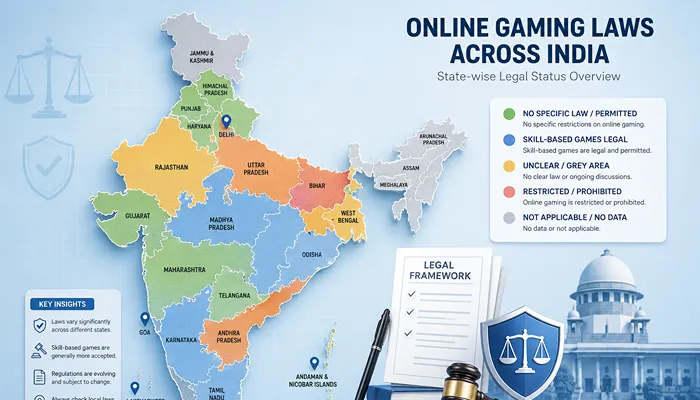
State-level bans still layered on top (Andhra Pradesh, Assam, Odisha, Telangana)
Even after the 2025 legal changes, state laws continue to play an important role. India does not have a single set of gaming rules that applies uniformly across every state.
States such as Andhra Pradesh, Assam, Odisha, and Telangana have laws or restrictions that can affect online betting or gambling activities. Because these rules differ from one state to another, a platform that is accessible online may still be restricted where a user is located.
Before participating in any real-money gaming activity, users should check the laws that apply in their own state, as state-specific restrictions remain enforceable alongside national regulations.
The Risks Nobody’s Telling You About
Payment Blocking — Banks Required to Block Transactions to Unlicensed Platforms
One risk many users overlook is payment disruption. In India, regulators have increased oversight of digital payments connected to unauthorized online gaming and betting platforms. Banks and payment service providers may block or decline transactions when they identify payments linked to unlicensed or restricted operators. This can affect both deposits and withdrawals.
If a payment is blocked, the transaction may fail, remain pending for some time, or be reversed according to the payment provider’s policies. While not every transaction is automatically blocked, users should understand that payment restrictions can change as financial institutions update their compliance measures. Before sending money to any platform, it’s worth checking whether it operates within the applicable legal and regulatory framework.
No Legal Recourse With Offshore Operators in a Dispute
Another important consideration is what happens if something goes wrong. Many online gaming or betting platforms operate through companies registered outside India. If a dispute arises over account access, withdrawals, bonus terms, or other issues, resolving it can be difficult.
Unlike businesses operating under a local regulatory framework, offshore operators may not fall under Indian consumer protection or dispute resolution processes in the same way. This means users may have limited practical options if customer support cannot resolve the issue. Before using any platform, review its terms and conditions, understand how disputes are handled, and check whether there is a clearly stated licensing and complaint process.

Tax Exposure Applies Either Way — 28% GST, 30% TDS on Winnings Over ₹100
Tax obligations apply regardless of how or where a platform operates. In India, online gaming is subject to a 28% GST on the value determined under the applicable GST rules for online gaming. In addition, under the Income Tax Act, online gaming winnings are generally subject to 30% Tax Deducted at Source (TDS), with the current rules applying to net winnings, including situations where the amount exceeds the applicable threshold under the law.
These tax rules exist independently of a platform’s location or marketing claims. Users should also maintain records of deposits, withdrawals, and winnings for their own tax reporting purposes. If you’re unsure about your tax obligations, it’s advisable to consult a qualified tax professional for guidance based on your individual situation.
So What Should You Actually Do?
If you’re thinking about using a real-money fantasy sports or betting app, it’s worth taking a few simple precautions before you deposit any money.
Start by checking whether the app is currently operating as claimed. Visit the platform’s official website or support channels and review the latest terms, policies, and announcements. If the platform says it holds a licence, remember that an offshore licence, such as one issued by Curaçao, does not automatically mean the service is legal or regulated for users in India.
You should also keep in mind that India’s legal position on online betting is not the same across the country. Different states have different laws, and some have stricter rules or restrictions than others. Before using any real-money platform, check the latest information that applies to your state.
A few sensible steps include:
- Verify the platform’s current legal and operational status.
- Read the terms and conditions before depositing funds.
- Check whether your state’s laws allow or restrict the activity.
- Never assume that advertising or social media claims reflect the legal position.
- Treat any real-money fantasy or betting product as a high-risk activity and only use money you can afford to lose.
Because laws, regulations, and platform policies can change, always rely on official sources and current state-specific information rather than outdated articles or online rumours. Staying informed is the safest approach before making any financial decision.
FAQ
No. Dream11 is not banned across India. However, its availability depends on the laws of individual states. Some states have restrictions on online real-money games, so users in those locations may not be able to access or participate on the platform. Before using any fantasy sports app, always check the rules that apply in your state.
Lotus365 is an offshore online betting platform and is not licensed under a single nationwide Indian gambling law. Whether an Indian user can access or use such a platform depends on the laws of their state and any applicable central regulations. Because the legal position varies, users should review local laws and understand the potential legal and financial risks before participating.
Fantasy sports generally involve creating a virtual team and earning points based on the real-world performance of selected players. Courts have, in some cases, treated certain fantasy sports formats as games of skill. Sports betting, on the other hand, usually involves wagering money on the outcome of a sporting event. The legal treatment of these activities differs and may also vary from one state to another.
Indian tax rules can apply to taxable gaming winnings regardless of whether the platform is based in India or overseas. Your tax obligations depend on the applicable provisions of Indian tax law and your individual circumstances. If you receive significant gaming winnings, it’s a good idea to maintain proper records and seek advice from a qualified tax professional to ensure compliance.